
You open the Absolute datasheet, and the line that jumps out is survives a factory reset. It sounds like the whole ballgame. But maybe your laptops are scattered across home offices, client sites, and three time zones. Or half of them are leased and rotate between users every few months. In that case, that line answers a question you may not actually be asking.
The buying checklist for a fleet that sits in one building is not the checklist for a fleet that's distributed or rented out. This guide is about the second kind. We'll cover when firmware persistence genuinely matters. Then the requirements that quietly decide these deals instead, and how to shortlist an alternative that fits a fleet in motion.
What changes when your fleet is distributed or leased
A distributed fleet breaks the assumption most endpoint tools were built on: that a device you can't see is still on your network. When a laptop lives at someone's kitchen table or a contractor's site, "manage it" starts with "find it" and "reach it." You do that on whatever connection it has, whenever it next checks in.
Leased and Device-as-a-Service fleets add a second twist. The device isn't a permanent asset you'll retire on your own schedule. It's on a clock. It gets provisioned, handed to a user, reassigned, returned, or, often enough, not returned. Every one of those transitions is a moment where you need to lock, wipe, re-enroll, or reclaim. A rigid tool turns each one into friction you pay for monthly.
Around half the buyers we talk to describe some version of "half my fleet is remote and I have no control over it." The pain isn't abstract. It's the manager who can't answer "do we know where this device is?" when the device is 400 miles away. Absolute is a capable platform, but its center of gravity is persistence and compliance reporting on hardware you own outright. That's a different problem than keeping a moving, rotating fleet visible and recoverable. Start your evaluation from your fleet's reality, not from the feature that photographs well.
Do distributed or leased fleets need firmware persistence?
Usually, no. Firmware persistence matters when a device is likely to be re-imaged or wiped and you still need the agent to come back. For most distributed and leased fleets, the deciding factors are how fast you can act and how flexibly you can manage licenses. Whether the agent reinstalls itself after a factory reset barely enters the picture.
Here's what firmware persistence actually is. On supported hardware from OEMs like Dell, HP, and Lenovo, Absolute's agent lives in the firmware. That lets it reinstall itself at the OS level even after a drive wipe or reimage. It's genuinely useful in a narrow set of cases: highly regulated environments, or fleets that get re-imaged constantly. There, the agent surviving that churn is the point.
Now the reality for everyone else. In an actual theft or loss, the device is rarely wiped to firmware before you act. A laptop left in an airport café. A contractor's bag stolen from a car. A loaner a student walked off with. None of those start with a bare-metal reimage. They start with a device that's still running its OS, checking in when it finds a connection. What you need in that window is the ability to lock and wipe now, not an agent that would have survived a reset that never happened.
There's also an honest tradeoff worth naming. Persistence lives in the firmware, which means it's tied to specific certified hardware. A fleet mixing Linux boxes, older machines, and whatever the last leasing batch shipped won't get uniform coverage anyway. As one G2 reviewer put it, "there is so much you can do with Absolute, it sometimes can be a little overwhelming." A lot of that surface area serves a persistence-first model a distributed fleet doesn't lean on.
Quick wins:
- Check whether your laptops even carry a certified persistence module (many mixed and leased fleets don't) before you pay for the capability.
- Ask your last three incidents a simple question: was the device wiped to firmware before you could act? If the answer is "no" every time, persistence isn't your bottleneck.
The requirements that actually matter for distributed fleets
If persistence isn't the deciding factor, what is? Four things. How fast the tool responds. How much of your OS mix it covers. Whether it runs multi-tenant. And whether its licensing bends when your fleet changes. Score alternatives on these before anything else.
Speed of response. When a device goes missing, the gap between "declared lost" and "locked and wiped" is where data exposure happens. This varies wildly between tools. In one team's testing, a rival endpoint product took 34 minutes just to initiate a remote wipe. On a distributed fleet, you're already waiting on the device's next check-in. Minutes of tool latency on top of that is the difference between containing an incident and reporting one. Test this yourself. For the mechanics of what a wipe does and doesn't guarantee, our guide on remote wipe covers the offline and reconnect behavior.
OS coverage, honestly counted. Distributed fleets are mixed fleets. If your alternative can't cover Linux, you're back to two tools. Absolute reviewers name this directly: "it does not support any kind of Linux." Count every OS you actually run: Windows, macOS, Linux, Android, iOS, Chromebook. Disqualify anything that leaves a gap you'll patch with a second product.
Multi-tenant management. If you're an MSP, or a DaaS operator managing devices across client accounts, one flat console is a daily tax. "The platform could be more user friendly and that it is not multi-tenant" is a recurring Absolute critique on G2. Separate, switchable tenants aren't a nice-to-have here; they're the operating model.
Licensing that moves with the fleet. More on this below. It's the one distributed-fleet requirement almost no datasheet lists.
Quick wins:
- Run a stopwatch test: from "mark as lost" to "wipe initiated," time each shortlisted tool on a real device.
- List your OS mix and cross out any tool that doesn't cover all of it natively. A corporate laptop tracking comparison is a faster way to see coverage side by side than reading spec sheets.
Leased and DaaS fleets: the license-recovery problem
Here's the requirement that quietly wrecks leasing and DaaS economics: what happens to the license when the device doesn't come back? On a permanent fleet, that's a rare edge case. On a leased or DaaS fleet, devices leave constantly: retired, swapped, returned late, or never returned. If each departure strands a license, you're paying for hardware you'll never see again.
This is a real switching trigger, not a hypothetical. One Device-as-a-Service operator running more than 700 devices moved off Absolute at renewal for exactly this reason. The licensing was rigid, and they couldn't recover credits for devices that never came back. The pricing critique that shows up across G2, "Absolute Software can be quite pricey compared to other software options," compounds when every lost unit also freezes a license you keep paying for.
Picture the DaaS operator's month. They ship 40 laptops to a client's new hires. Three months in, the client offboards a dozen people. Four devices come back clean, five come back late, three never surface. With rigid, serial-locked licensing, those three no-shows are dead weight on the invoice. With reassignable licensing, the operator removes them and the license slots go straight to the next batch. Same fleet, very different unit economics.
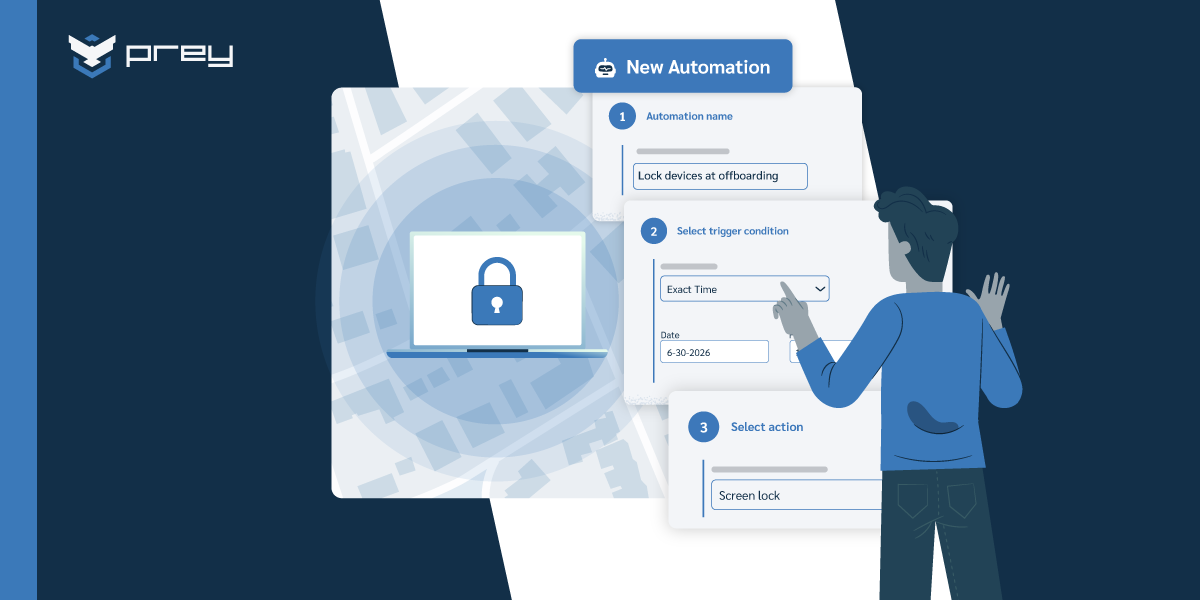
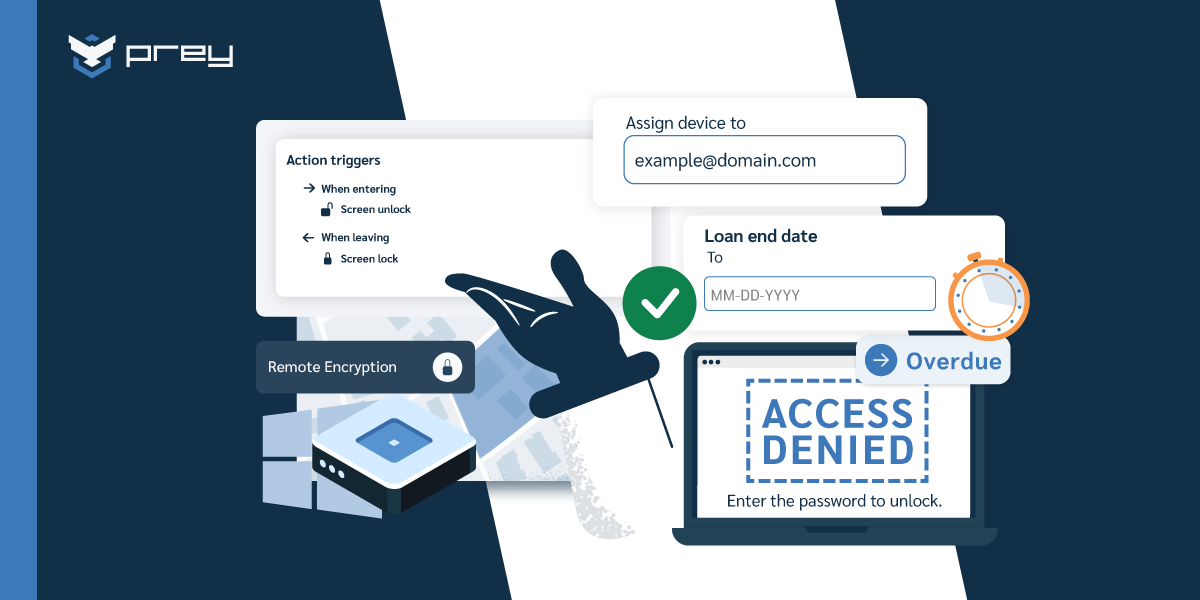
The tool for the late and never-returned devices is a loan or assignment workflow. It tracks who has what, what's overdue, and auto-locks a device that blows past its return date. That turns "chase the ex-user" into a policy the system enforces. It also keeps offboarding from depending on someone remembering to revoke access. Frame it as process, not pursuit, the device side of a clean handoff.
How Prey fits distributed and leased fleets
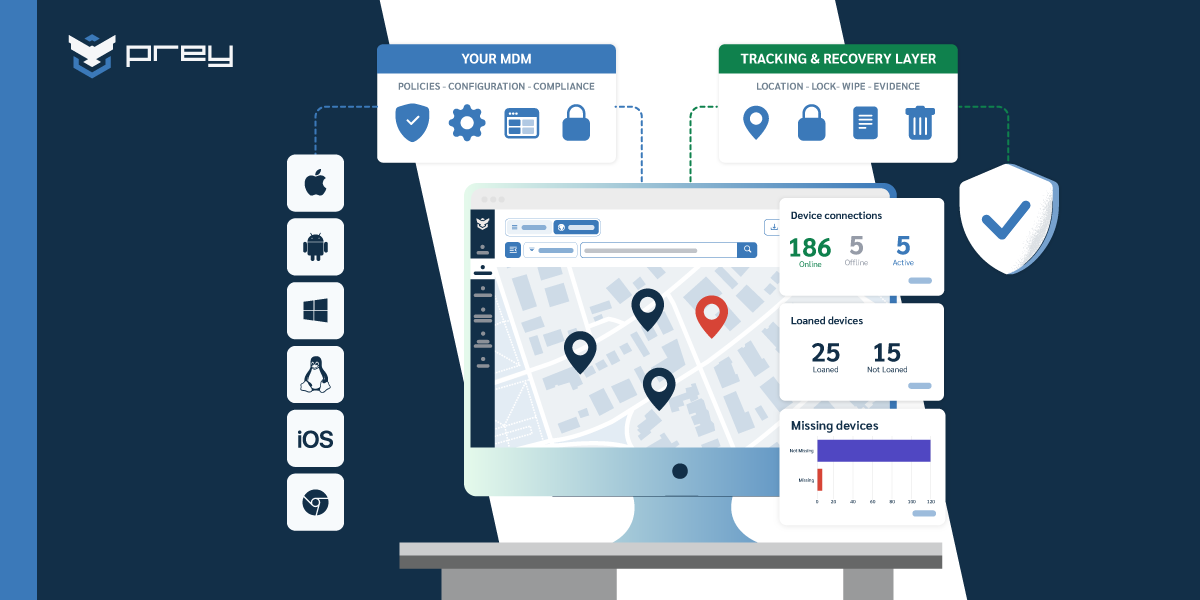
Prey is built for the fleet-in-motion problem and is honest about one tradeoff: it runs at the OS level, so it has no firmware persistence. If you need an agent that survives a bare-metal reimage, Absolute does that and Prey doesn't. Here's how Prey lines up against the four requirements above.
For context on where it lands with buyers: Prey holds a 4.7/5 rating across 57 verified G2 reviews (2026).
Speed and reach. Prey gives you always-on tracking and remote lock and wipe across the whole fleet. When a device checks in, the action you queued executes without a 34-minute runway. Location history helps you recover the "lost, not stolen" devices a distributed fleet generates constantly, like the laptop that surfaces at a café counter weeks later.
OS coverage. Windows, macOS, Linux, Android, iOS, and Chromebooks under one account. The Linux gap that pushes teams off Absolute isn't a gap here.
Multi-tenant. The MSP portal lets you add, remove, and manage devices across separate client accounts, the operating model DaaS providers and MSPs actually run on. G2 reviewers coming from Absolute call this out directly: "as an MSP, the portal gives us the options to manage separate customer accounts with ease."
Licensing that moves. Prey licenses are tied to a slot, not welded to a serial number. When a device is retired, lost, or never returned, you remove it and reassign that license to the next device. Pair that with auto-lock on overdue loans and Loan Manager to see what's out and what's late. A device that walks away stops being a license you keep paying for.
Quick wins:
- Turn on disk encryption (BitLocker or FileVault) as your real data backstop, it protects the data whether or not the agent survives anything.
- Set an auto-lock to trigger on overdue loans or geofence exit, so containment doesn't wait on a human noticing.
- Reassign a freed license the moment you retire a device, instead of letting it sit stranded.
For a side-by-side on cost, Linux support, and multi-tenancy, the Prey vs Absolute comparison lays it out feature by feature.
Choosing your alternative: a checklist for distributed fleets
Pick your Absolute alternative by scoring it against how your fleet actually behaves: distributed, leased, mixed-OS, multi-client. Not against the feature that leads the datasheet. Five questions settle most shortlists.
- Were your last incidents wiped to firmware before you could act? If no, deprioritize persistence and weight speed instead.
- How long does each tool take to initiate a lock and wipe? Time it on a real device; treat anything in the tens of minutes as a red flag for a distributed fleet.
- Does it cover every OS you run, natively? Any gap means a second tool and a second bill.
- Can you manage tenants separately if you're an MSP or DaaS operator, without a workaround?
- What happens to a license when a device never comes back? If the answer is "you keep paying," that's your leasing math getting worse every quarter.
If firmware persistence tops your list because you're in a regulated, reimage-heavy environment, Absolute earns its place and you should keep it. If your reality is a fleet that's spread out and rotating, weight speed, OS coverage, multi-tenancy, and flexible licensing. The alternative that wins there will serve you better and usually cost less. Line your shortlist up against those five questions and the choice tends to make itself. If a full reset is part of your process, our factory reset guide covers what actually clears and what doesn't.
FAQ
Does Prey have firmware persistence like Absolute?
No. On supported hardware, Absolute's agent can survive an OS reinstall because it lives in the firmware; Prey runs at the OS level and does not. In practice, most lost or stolen devices are never wiped to firmware before you act, so Prey's always-on location, lock, and wipe cover the large majority of cases at a fraction of Absolute's cost and complexity.
Do distributed or leased fleets need firmware persistence?
Rarely. Persistence matters most in regulated or reimage-heavy environments. Distributed and leased fleets are usually decided by response speed, cross-OS coverage, multi-tenant management, and license flexibility, factors that determine day-to-day cost and containment far more than whether an agent survives a reset.
What is a cheaper alternative to Absolute Secure Endpoint?
Prey starts at $1.30 per device with a 14-day trial, so small and mid-size fleets pay for what they use. You get always-on tracking, remote lock, and wipe across Windows, macOS, Linux, Android, and Chromebooks. The Prey vs Absolute comparison breaks down the cost and licensing differences.
What is a better alternative to Absolute for a fleet that's spread out or leased?
For distributed and leased fleets, "better" means faster response, full OS coverage, multi-tenant management, and reassignable licensing. Prey was built around those requirements, including reclaiming license value on devices that never come back, which is where rigid, serial-locked licensing costs leasing and DaaS operators the most.
How does Absolute maintain application health across distributed laptop fleets?
Absolute uses its firmware-embedded agent to reinstall and monitor software and report compliance status, even after an OS reinstall on certified hardware. It's a persistence-first model. Whether that's worth the cost for your fleet depends on how often your devices are actually re-imaged, and whether you'd rather invest in response speed and flexible licensing instead.
Ready to evaluate the fit?
If your fleet is distributed, leased, or mixed-OS, the fastest way to see whether an alternative holds up is to run it against your own devices. Start a 14-day trial (extendable to 30 days, no credit card to begin), or compare the two head to head in the Prey vs Absolute breakdown.